A 28-page trade site that updates itself: TB Plumbing & Gas
A 28-page trade website with a custom admin panel — so a Gas Safe engineer can post completed jobs and watch the gallery and blog update themselves.
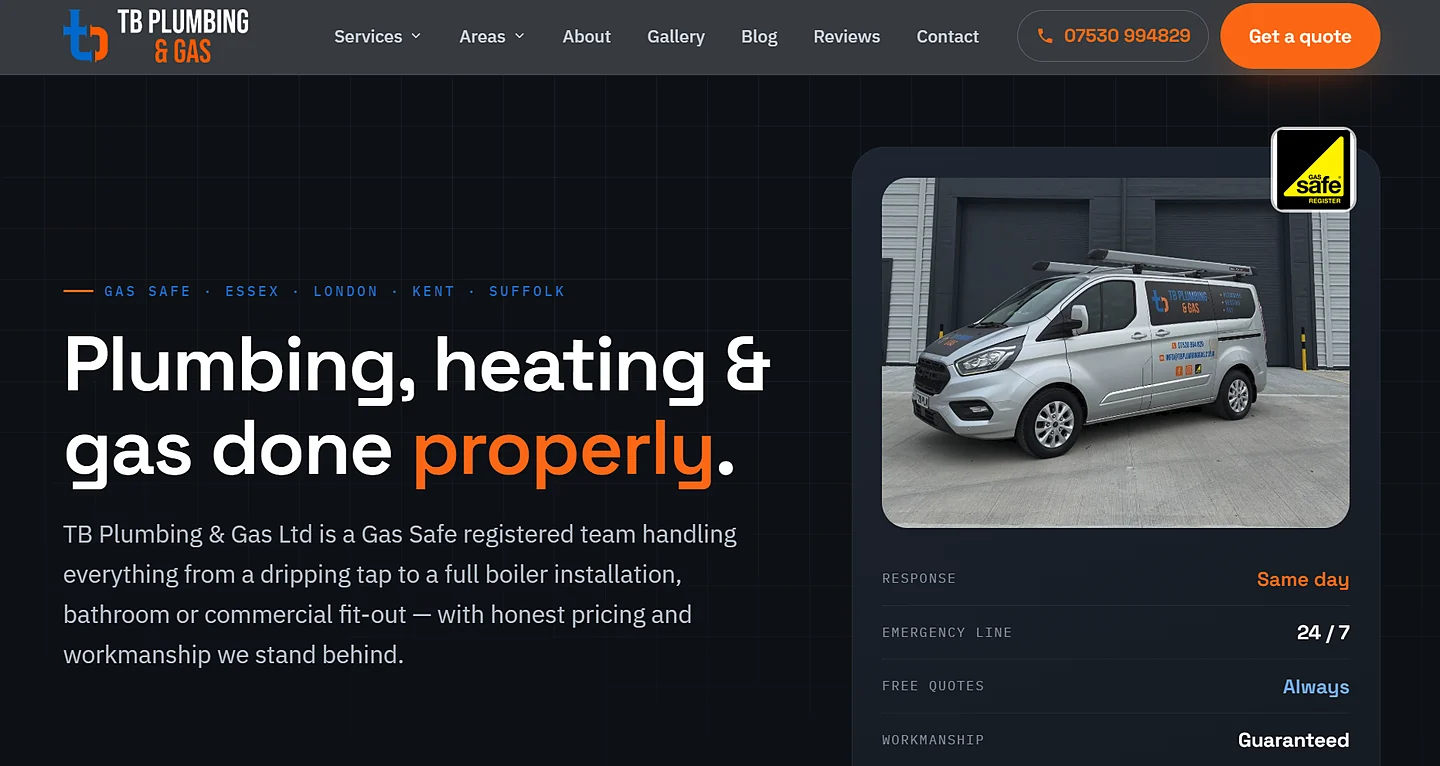
TB Plumbing & Gas Ltd is a Gas Safe registered plumbing and heating firm covering Essex, Kent and the surrounding areas. Like most established trades, they didn't have a "no website" problem — they had a more common and more insidious one: a website that would go stale the moment it launched. They wanted a site that looked genuinely professional, ranked for local searches, and — the part that actually shaped the whole build — that they could keep fresh themselves, without paying a developer every time they finished a job.
The problem: the trade website that dies quietly
There's a predictable life-cycle to most trade websites. A firm pays for a site, it looks fine on launch day, and then nothing ever changes — no new photos of completed work, no fresh content, no sign the business is even still active — and slowly it drifts down Google while competitors who keep their sites alive climb past it. The reason is almost never laziness; it's friction. Updating the site means emailing a developer, waiting, and often paying, so a busy engineer who's on the tools all day simply never does it. The obvious alternative, a heavy content-management system like WordPress, brings its own problems: bloat, security upkeep, plugin costs, and an admin experience most tradespeople find fiddly and off-putting. TB's brief cut straight to this — make it professional, make it rank, and, crucially, put the owner genuinely in control of the content.
The approach: a professional site the owner actually runs
Twenty-eight pages, hand-coded for speed and search
The foundation is 28 pages, hand-coded rather than assembled from a template: individual service pages, town-by-town area pages, an about page, a gallery, a blog, reviews and contact. Hand-coding matters here for two concrete reasons — speed and search. A hand-built flat-file site loads faster than a plugin-laden CMS (which helps both users and rankings), and it lets every page be deliberately structured and targeted rather than squeezed into a generic template. The town-by-town area pages are the SEO engine: instead of one homepage trying to rank everywhere, each area gets its own page targeting how people in that specific place actually search.
The centrepiece: an admin panel that updates the site for them
This is the part that makes the whole thing work. TB has a custom, flat-file admin panel built around a single job — the engineer logs in, adds a completed job (a few photos and a short description), and the site publishes it itself. That one job lands automatically in the gallery and as a blog post, with no code and no waiting. It's hard to overstate how much this changes both the economics and the outcome. Keeping the site fresh now costs nothing but the two minutes it takes to upload a job the engineer just finished — so it actually happens. The gallery fills with real, recent work; the blog grows steadily; Google sees a living, active business; and TB never sends a "can you update my site?" email or pays a per-change fee again. It turns the website from a static brochure that decays into a living record of the work that compounds over time.
Lightweight by design — no bloat, no monthly fees
A deliberate decision underpins that panel: it is not a heavy CMS with monthly costs and constant updates. It's a lightweight, flat-file panel that does exactly one thing well — publish a job to the gallery and blog — and nothing it doesn't need to. That restraint is the point. No plugin bloat slowing the site down, no security surface to maintain, no subscription creeping up every year, and an admin screen simple enough that a busy engineer will actually use it rather than avoid it. For a trade business, "simple enough that you'll actually use it" beats "powerful but fiddly" every time.
Found on Google — and by AI
Every page ships with technical SEO and structured data baked in, the area pages target real local searches, and there's a sitemap plus an llms.txt file so AI search tools read the business correctly. That last detail matters more each month: as people increasingly ask ChatGPT or Perplexity for a local plumber rather than scrolling Google, a site that's cleanly structured and explicitly readable by those tools has a real edge over competitors whose sites are invisible or garbled to them.
Trust built into the first impression
Plumbing and heating is an emergency-driven, trust-driven purchase — often someone with a leak or no heating, deciding fast who to call. So the things that earn that call are front and centre the moment someone lands: Gas Safe registration, same-day response, a 24/7 emergency line, and guaranteed workmanship. In a trade where anyone can put up a website, visible, specific credentials like Gas Safe registration do a lot of quiet work — they're the difference between "I'll risk this one" and "I'll keep looking".
The result
TB Plumbing & Gas has a site that does the three things the brief asked for, and one more it implied. It looks genuinely professional; it's built to rank locally through its area pages and technical SEO; and — the quiet win — it stays fresh, because the owner can update it in two minutes from his phone after a job, with no developer and no fee. That last point is what makes it a lasting asset rather than a snapshot that ages. Every job added is another gallery image, another blog post, another signal to Google that this is an active, working business — a site that gets better the more it's used, instead of slowly going out of date.
What it shows
The best trade website isn't the one that looks best on launch day — it's the one the owner will actually keep alive. Most don't, because updating them is a hassle; TB's does, because it isn't. It's a good illustration of building around how a business really operates rather than how a template assumes it does: a busy engineer doesn't want a CMS, he wants to upload a job from the van and get on with his day — so that's exactly what the site lets him do, and everything else (fresh content, better rankings, a living gallery) follows from that one well-judged decision.
https://fisher.digital/blog/tb-plumbing-gas-website/Want a website like this?
I design and build fast, bespoke sites for businesses across Essex and the UK. Tell me what you're working on.
Related: The Orion Performance build · The Essex Headlight build · Websites for plumbers